# 27 Build the Base — Durability, Longevity, and a Body That Lasts
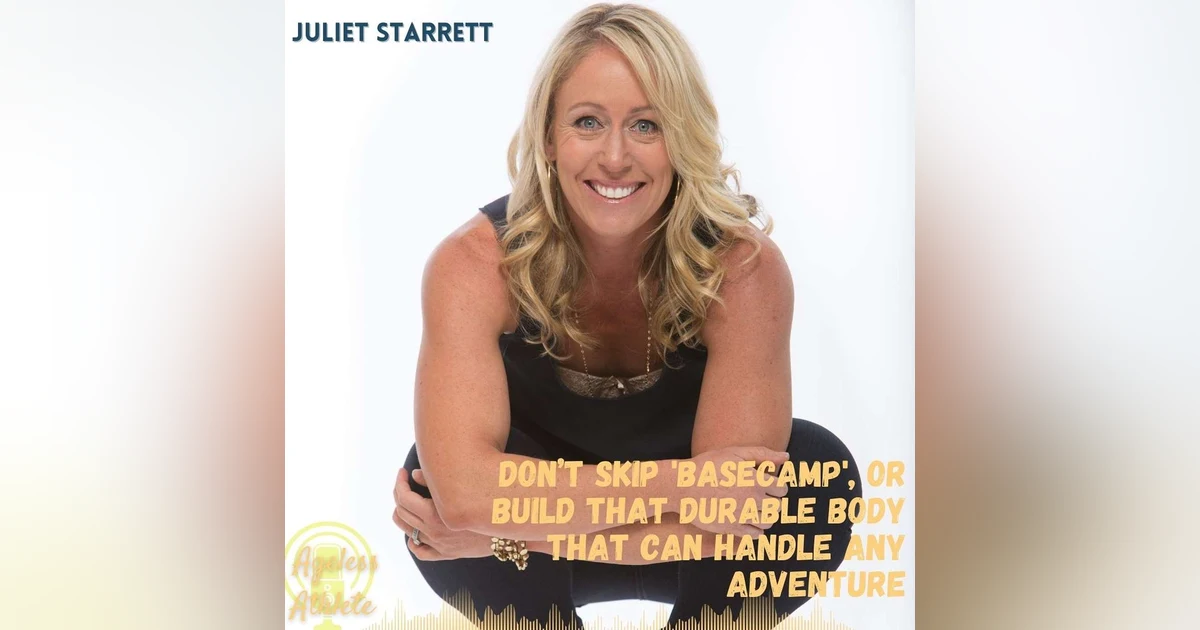
"Forget the "long slow rot" of aging! 🙅♀️ Juliet Starrett, a world-champion whitewater rafter turned fitness advocate, is on a mission to empower us all to build durable bodies that can handle life’s adventures – at any age! Juliet unpacks her powerful "Base Camp" philosophy: reminding us that even lifelong athletes need to remember to sheerproof the basics. I loved her wisdom on weaving in practices into our daily cycles without expensive gizmos, going to yoga classes, or making time for ...


"Forget the "long slow rot" of aging! 🙅♀️ Juliet Starrett, a world-champion whitewater rafter turned fitness advocate, is on a mission to empower us all to build durable bodies that can handle life’s adventures – at any age!
Juliet unpacks her powerful "Base Camp" philosophy: reminding us that even lifelong athletes need to remember to sheerproof the basics. I loved her wisdom on weaving in practices into our daily cycles without expensive gizmos, going to yoga classes, or making time for a fancy gym.
- You can optimize your sleep and rest WITHOUT a tracker! 😴
- Why and how to ‘rewild your hips’! 🧘🏼♂️
- Strength and balance training is essential for building an ageless body that can handle any challenge. 💪
- The "unsung heroes" of longevity like balance and mindful movement. 🤸♀️
Head to the podcast! Link in bio! 👆
“Built to Move” is an amazing book that you need to have on your bedside, as I do on mine! 📗And you can also enroll for a fun 21 day challenge on the website for by @thereadystate! Do it!
The Ready State: Juliet's company [https://www.readystate.com/]
References:
Books:
Built to Move: The 10 Essential Movements to a Pain-Free Life by Kelly Starrett and Juliet Starrett [https://www.amazon.com/Built-Move-Essential-Movements-Pain-Free/dp/1684030302]
Forever Strong: Unleash Your Inner Athlete by Dr. Gabrielle Lyon [https://www.amazon.com/Forever-Strong-Unleash-Inner-Athlete/dp/1476762998]
Companies and Products:
Whoop: Wearable fitness tracker [https://www.whoop.com/]
Aura Ring: Wearable fitness tracker [https://auraring.com/]
Slack Block: Balance training device [https://www.slackbow.com/]
Additional Resources:
Optimize Me Nutrition: Nutritionist on Instagram [https://www.instagram.com/optimizemenutrition/]
Interesting individuals mentioned in the show!
Nick Gill: Longtime strength and conditioning consultant for the All Blacks (New Zealand national rugby team)
Dr. Kirk Parsley: Sleep researcher, expert on supporting Navy SEALs
Dr. Kristin Holmes: Sleep researcher with Whoop
Dr. Gabrielle Lyon: Author of "Forever Strong," advocating for strength training for longevity
Brian Johnson: Tech entrepreneur and human longevity experimenterJimmy Chin: Climber, filmmaker, and photographer [https://www.jimmychin.com/]
Other References:
The Blue Zones: Areas with high concentrations of centenarians [https://www.bluezones.com/]
Atomic Habits by James Clear: Book on habit formation [https://www.amazon.com/Atomic-Habits-Proven-Build-Break/dp/0735211299]
The Khumbu Icefall: Dangerous section on Mount Everest [https://en.wikipedia.org/wiki/Khumbu_Icefall]
---
🚀 Love the show? Here’s how to support it
If something you’ve heard here has stayed with you, made you smile, or helped you keep going, I’d be honored if you’d consider supporting the show. 👉 https://buymeacoffee.com/agelessathlete
📰 Subscribe to the Ageless Athlete newsletter !
1-2x a month, no spam. We share behind-the-scenes reflections, longevity tips, and athlete wisdom you won’t find anywhere else. You can sign up at https://www.agelessathlete.co/newsletter/ 📩
23:21 - [Ad] Resilience Podcast Series
23:45 - (Cont.) Build the Base — Durability, Longevity, and a Body That Lasts | Juliet Starrett
Ageless Athlete - Juliet Starrett
===
Kush: [00:00:00] Juliette, uh, great to have you on Ageless Athlete. Please tell us where are you and, uh, what did you have for breakfast this morning?
Juliet: ~Well, first of all, thank you so much for having me. And I loved getting a chance to meet you at the Outside Festival. I actually am dialing in to use an old school phrase from Southern California today. Um, My husband and I are down here because our daughter is playing at a water polo camp. Um, but I actually live in Marin County, California.~
Juliet: ~So, um, very close to you. And, uh, ~this morning for breakfast, I had some coffee, which is my lifeblood. I love coffee. And a little bit of oatmeal mixed with some protein powder and some blueberries and raspberries.
Kush: Amazing. Uh, sounds like a very, uh, wholesome start to the day. So hang on. So you're traveling, you're in a new place. Are you carrying your, uh, your nutrient kit with you so you can stay consistent with your,
Juliet: So I do, it kind of, you know, I'm lucky on this trip to be, uh, you know, it's, we're road tripping. So we have our car. Um, so people would laugh if we, we drove our truck down here and people would laugh if they saw the back of our truck, because we really take full advantage of having a lot of space when we travel, [00:01:00] uh, in our car and we do bring a lot of stuff.
Juliet: So I almost always travel. with a couple key things. Um, from a supplement standpoint, and I can talk more about that later, but I always make sure I have some kind of protein with me. Um, and you know, we're lucky enough to be staying in an Airbnb. So we have a kitchen, we can buy food, you know, we can sort of have a normal food situation, but regardless of whether I'm plane traveling or normal traveling, I always bring some kind of protein. Um, I bring creatine with me. Um, because we are road tripping and we are giant nerds, Kelly and I each brought a sandbag and a kettlebell in the back of our truck, because you just never know when you're going to have a chance to do something. So we have a sandbag each in the back of our car, we brought, we brought a Frisbee, um, because one of the things that we're, uh, huge fans of and think have been lost in this fitness industrial complex is the art of play.
Juliet: So we always try to. Create opportunities to [00:02:00] play more and just having a frisbee on hand is like one of the best ways we've known to do that because you can play frisbee anywhere. And, and then, you know, I do take magnesium before I go to bed. So I bring that, um, you know, but my, my, um, sort of die on the vine things are bringing some protein and some implements to exercise with if I can.
Kush: I love that. I have been known to bust out my resistance bands at airport and corners, trying to make sure I get my mobility in and absolutely being able to have some reliance on reliance and also Reassurance that one can get, uh, foods that one's body needs with all the vagaries that, you know, travel, uh, brings is so important for both for body and for perhaps peace of mind.
Juliet: You're so right and, you know, [00:03:00] I forgot to add, I, I have to add a couple other things. I do always bring some kind of mobility tool, like a
Juliet: ball. Uh, you know, we make a product called a supernova, but if I don't have room for a supernova, I bring a lacrosse ball. So I always bring some kind of mobility thing, because again, you never know.
Juliet: One of the things that has really changed though. In travel because I do a lot of plane travel is it is possible these days to get decent food in an airport, um, if you try and, um, and I think that that's sort of a changed universe. I mean, obviously it depends airport to airport, but, um, You know, my go to often at the airport is to get like a couple of hard boiled eggs and a coffee and a banana and
Juliet: an apple and an orange.
Juliet: You know, if you, if you stopped me in any airport and had me open my backpack, you'd find like a mobility tool, a banana and apple, an orange, some kind of protein powder, and like a couple eggs. Um. So I think it's getting a lot easier these days. There's always an option. [00:04:00] Um, in fact, I started making a while ago.
Juliet: I make a couple of them a year, but I call them Juliet's gas station lunch. Um, because I've figured out, you know, gas stations have also improved, you know, convenience stores of gas stations. I mean, You know, my kind of go to a gas stations is, you know, you can get these little bags now of pickles, um, hard boiled eggs, there's cheese, uh, you know, the, the type of protein bar has improved.
Juliet: So you can get protein bar beef jerky. So, you know, I do these little Instagram posts whenever I'm on a road trip, uh, called Juliet's gas station lunch, um, because I figured out a way to get a pretty decent. gas station lunch. And believe it or not, most gas stations actually somewhere in a corner have like a bowl of fresh fruit and it's not going to be the greatest fresh fruit you ever had. You know, it's not like from the farmer's market in Marin County where it's like perfect, but like it does exist out there. So I figured out these little ways to sort of make sure I get enough protein and fruits and [00:05:00] vegetables as I'm on the road. Wherever I am.
Kush: I love it. I love it. One just has to stay away from those, uh, gallon containers of soda for 99 cents. And if you look beyond that, there are, uh, there are options now available that were not Not, uh, that, that was simply not present, uh, even maybe, uh, uh, a few years ago, uh, Juliette, um, you're racing ahead here.
Kush: There's so many things that, uh, you brought up that I want to dive into, but, uh, before we do that, please tell us who you are and what do you do?
Juliet: Sure. Um, I am my title is I'm the CEO of the ready state and for people who haven't heard of it. We are a digital musculoskeletal care and movement company. Like you we also have a podcast and we've written quite a few books. Our most recent book is called built to [00:06:00] move We've spent most of our career trying to help the best athletes get better So we've worked with professional teams of all stripes Olympians We've worked a lot in the military and, um, and other professional organizations, uh, just trying to figure out, you know, what small little, you know, levers we can pull to help athletes and teams get better. But as Kelly and I have gotten older, and it sounds like we share this in common, um, our interests have changed a little bit. We still do work with the best athletes and teams, and that still excites us, but we're also really interested in, Trying to figure out how we can take those lessons that we've learned in the high performance world and sort of translate transmute them to the rest of us. Um, because we're both, uh, I turned 51 this year, Kelly turned 50. Um, you know, we are starting to sort of stare into older age and realize that we really want to have a body that can be able to do the things [00:07:00] we love to do. And we realize that a lot of the things that we work with our professional athletes at sort of optimizing are also the same things that the rest of us can do to keep our bodies feeling good and healthy and able to do the things we love to do. have a plan of staying out of the nursing home, so to speak. So our book built to move was really our sort of effort to say, Hey, these are the lessons we've learned. These are the basic things that we think all humans should be able to do and should be doing and keep an eye on if they want to feel good in their bodies.
Juliet: So that's been our latest mission.
Kush: Your mission is inspiring and the ability to take all those hard won strategies that elites have benefited from and have them now be available to the everyday person, the everyday athlete. is, uh, yeah, can be transformational. Juliette, you didn't [00:08:00] just end up here, you know, with, uh, this, uh, this role and this mission.
Kush: The little that I know about you, you, amongst your many accomplishments, you were whitewater rafting at the highest level, right? So this is particularly interesting to me, like I shared, My podcast goes out to adventure athletes and use their stories to inspire everybody else. Would love to know a bit about your origins.
Kush: Were you always an athlete? Were you always a gifted, uh, outdoor, outer person? How did you get into, uh, your sport?
Juliet: Sure. You know, and thanks, thanks for asking that. I mean, you know, to the extent that your listeners are outdoors people, like you are my people, because that's how I, I sort of think of myself as an outdoors person. Like I almost think of myself more as an outdoors person than an athlete. You know, I grew up in Boulder, Colorado.
Juliet: My parents were outdoors people. So I was lucky enough to, [00:09:00] um, you know, have a childhood that was filled with camping and backpacking and river trips and skiing, um, fishing. You know, you name it. My dad was my dad in particular was very outdoorsy. So we just, you know, that's what we did We also didn't have a lot of money Um, and so that that's what was available to us for, you know, family vacations was going camping um, so that's what we did and so I really fell in love as a as a little kid with The pace and the smells and sounds and like exhilaration that comes with being outdoors.
Juliet: I love that. Like, I really fell in love with it. It's interesting. My brother, my older brother didn't fall in love with it and we have the same parents. You know, he's like this urban guy who lives in Los Angeles and like, you know, could care less about doing outdoor activities. So for whatever it's worth, it didn't land for him, but it landed for me as a kid. And, um, I loved [00:10:00] how, uh, it helped me connect and be around people. And, you know, obviously this was, uh, because of my age, this was pre technology, but I just, I, I loved doing anything, everything outdoors. Like that's what I related to. Um, I will say, I don't think I'm a gifted athlete at all. I definitely played all sorts of sports as a kid.
Juliet: Um, and then in high school, I moved to Southern California, um, for the last two and a half years of high school. And I discovered the sport of rowing. Um, And so I rode in high school and then I, uh, was a division one rower at UC Berkeley. Um, and I have tons to say about that in terms of the era and all of the mistakes we made and how much of a better athlete I could have been knowing what I know now, but that's maybe a separate conversation we can talk about later. But, um, I then, uh, was seeking a summer job as an 18 year old. uh, you may have heard me mention this at the outside [00:11:00] festival, but I had a couple of goals in mind. Um, one of them is I wanted a job where I could be outside. The second was I wanted to be tan. And the third was I wanted to be around some like cute boys. That was my 18 year old brain at work, right? So, uh, so I'm a division one rower and I decided to go to whitewater rafting guide school over my spring break, my freshman year of college. So, um, so I, that began my career as a river guide and I was lucky enough to work. Um, I actually guided almost 10 seasons.
Juliet: I worked rivers all over California, Oregon. I did a But what happened is after I graduated from college, I became aware of this weird fringe, extremely fringe sport called extreme whitewater paddling, which is done in a raft, not in a kayak. Um, and what's interesting about the sport that I learned is that in the U.
Juliet: S. it's like really, really fringe, like, Most people have never heard of it. They, you know, they think [00:12:00] of rafting as like a recreational thing they do. They do not think of it as a competitive sport, but it turns out in a lot of countries, it's a serious competitive sport. You know, a lot of Eastern European countries, um, quite a few Asian countries, you know, Australia, New Zealand, you know, these are teams that are like funded by their government.
Juliet: It's serious. There's been talk of making this an exhibition sport in the Olympics, but when I was doing it, it was like a fringe sport nobody had ever heard of, but it did perfectly. Mary. My background as a rower, you know, my ability to, you know, pull hard on a thing and be able to suffer. And my experience working as a guide, being able to read and run rivers. So, um, I made the, the national whitewater team in 1997. And six months later, we were competing in our first world championship on the Zambezi river in Zimbabwe,
Kush: Mm. Mm.
Juliet: we won. Um, And it just serves so many purposes for me. I mean, I love being an athlete. I loved having [00:13:00] the opportunity because we competed in races in, you know, Argentina, Costa Rica, Chile, twice in Africa, um, you know, all over the U S.
Juliet: And so I think it really served this like purpose of being able to travel as all over the world as a young person. Um, You know, sort of combine these like weird athletic skills I have. Um, and the reason I don't say, I say, I don't think I'm a great athlete is that I don't actually think I'm a very skilled athlete.
Juliet: Like, I don't know that I would have been the best like team sport, ball sport athlete, but what I'm really good at, what I'm really good at is suffering, which is a great quality to have in rowing. Um, and I'm coachable, you know, I'm coachable. So I think I was able to take those two things, um, and, you know, bring them together to, you know, go compete on these crazy rivers.
Juliet: And what's crazy about this sport is that, you know, they would host all our world championship events on the biggest class five whitewater rivers on earth. [00:14:00] Zambezi, the Fudulefu, um, a river that's now underwater called the Reventazon in Costa Rica. Um, and you know, part of their goal was to make these races good television and, and they're good, they're good television when they're on these crazy rivers where we're all flipping rafts and having carnage everywhere.
Juliet: Um, and so it was really, you know, it was really full on, you know, I mean, it was, it's really, you know, to go from a sport like rowing, which is very controlled. Um, and. To then go to a sport that, you know, you're out in nature, the river is different levels every day, you know, you can scout and plan, but there's only so much planning, you might have a surge in a rapid that flips your raft, um, where you're, you know, it's really often you're going through rapids where if you swim or have a bad situation, you know, you could die. Um, it was a wild experience, but. Man, it was so fun. And I'm still connected to my teammates to this day. And, [00:15:00] you know, it was, uh, it was a great, great five year period of my life being a professional athlete.
Kush: What a great story there. One thing we immediately have in common, I also, uh, started, I got the bug for the outdoors because my family, we would go backpacking in the Himalayas when I was a kid. And those were transformational experiences. I think I hated that as a child, you know, I would rather be at the beach with the other kids or at my grandparents house rather than, um, You know, picking bugs out of my soup at night.
Kush: And then, and then like you, uh, I was also not very gifted, but I think just the sheer dent of, uh, the love for adventure and, uh, and for being outside and for being able to recreate in these beautiful places. I mean, some of those spaces that you've been to seem incredible.
Juliet: Can I just
Juliet: say for a second, I have to
Juliet: interrupt you to say like, what a flex that is to say that like you grew up backpacking in the [00:16:00] Himalayas as well. A child like that is such a Flex . It's so awesome. You know, it's like as like an American, you're like, oh yeah, I was in the Rocky Mountains, but you're like, I was in the Himalaya.
Juliet: It's pretty amazing.
Kush: Well, when I was a kid, Part of my drive to, uh, maybe travel and move to the U. S. as an adult was, was the, that Hirshford venture. And for me, maybe what seems, uh, you know, striking to you was what seems striking to me when I would hear of, uh, you know, people in the West, people like yourself and you would go, uh, you know, skiing or, or climbing or rafting, you know, over the Rockies or whatnot.
Kush: I mean, I would. I would feel that same sense of exotic, um, uh, delight.
Juliet: Yes. I feel you.
Kush: So it's, it's, it's,
Kush: it's, it's amazing. It's amazing. Yeah. And I, I also think that, you brought this talent for, or maybe there's background in drawing. And, uh, this friend of mine, Skyler, who's also got a [00:17:00] drawing background.
Kush: I mean, he's, he's one of the most, uh, He's one of the fittest people I know. He can just pick up any sport and I think he credits his background and the discipline he got from rowing. You took that background, uh, and the discipline and the athleticism, you combine that with perhaps your love for adventure.
Kush: And it sounds like there was a balance of like both, um, you know, love for the sport, love for travel, and also maybe, uh, some astute thinking on picking the right sport where you could bring, you know, your strengths to, to
Kush: bear and, uh, take that forward
Juliet: I think you're right. You know, I talk, I, I do some consulting and talk with a lot of entrepreneurs about. How to be an entrepreneur. And one of the things that I think is the most important quality of entrepreneurship is self awareness. Um, and I think that's true. I think one of the reasons I've been successful as an entrepreneur is self awareness.
Juliet: I know what I'm good at and I know what I'm not good at. Um, and I think that that same sense is, is exactly what you're [00:18:00] picking up on. Right? Like I sort of knew, uh, Um, where I could be successful as an athlete and where I couldn't. And so I gravitated towards doing things where I knew I could be successful.
Juliet: And, you know, just a quick comment on the discipline thing. I mean, man, you know, uh, I had this really, I got together with, I had a reunion with some of my Cal rowing friends, maybe 10 years ago, and, uh, And I was blown away by how successful this group of women were. I mean, I'm telling you, there was not like a slouch in the group.
Juliet: Like everyone had like three PhDs and were physicians and CEOs of companies. And I actually wondered to myself afterwards, like, was it, are there, are there people who are sort of disciplined and, an ambitious, drawn to rowing, or is it the discipline created by being a rower launches that into high achieving positions?
Juliet: I don't know. I didn't come up with an answer to that, but, um, I just [00:19:00] had to, you know, double click on your comment. About the discipline piece because I think it's I don't know. I haven't figured out the answer to that question I don't know whether you gravitate towards it because you know, you're an achiever or whether you become an achiever
Juliet: by doing the sport
Kush: Intriguing question, indeed. Uh, one immediate thought I have, and I think back of some of the people I, met who, uh, who were climbers and whatnot. The ones who kept climbing and kept focused, I mean, that's one set of people, but then the ones who took again those lessons and applied them in a different field, they also succeeded quite highly.
Kush: But then there's also that group of people, you know, you know, who, who were, let's say more lifestyle climbers and who continued on that path and maybe they found ways to, uh, uh, get paid in some other profession and they're also cruising in that path as well. So maybe I think it's the level at which you pursue a specific sport.
Kush: And I think if you bring that kind of, [00:20:00] uh, ferocity. To, uh, other disciplines, you know, you will probably succeed maybe once that bug bites you and you, uh, like, and some of the things you said are so important, like you have that self awareness on the gifts you have and the ones you don't and the ones you need to be coached with.
Kush: Fast forwarding a little bit, you, if I understand correctly, you then Went on to develop, uh, a career as a, uh, successful lawyer, but at some point you quote unquote chucked it all to, uh, launch this mission ~in, in, in, in, in,~ in, in fitness, any pivotal moments where you realize that, uh, as successful as you could have been in the field of, uh, law, you were Actually going to realize your potential in a, in a greater
Kush: way with what you're doing today.
Juliet: Yeah, so I think I'll go back, you know to tell the story and you're right I [00:21:00] did I you know after I got tired of Being a dirtbag, uh, professional athlete and river guide. I was like, all right, it's time to make some money and, you know, make something of, of myself, use my Cal undergraduate degree for, for a purpose. Um, so I decided to go to law school. Um, but you know, in retrospect, I think, uh, law school is the place where like, I find that people who are good at school and kind of smart, but aren't sure what they want to do, go do, often, which may not be the right reason. Um, you know, I've always loved school, like I'm a school person, and so I knew that I could do well in law school.
Juliet: And, um, so it just seemed like a natural next step for me. I I just, I felt like I sort of took a detour after my undergrad and did this professional athlete thing, which was cool, but I was like, it's time to get serious. Um, but the other motivator for me in going to law school was I grew up with a single mom. Um, and. You know, she was a, a very highly regarded [00:22:00] journalist. She's still alive, but she's retired, uh, highly regarded journalist in Colorado and worked for the Denver post and Boulder daily camera, but she was always financially struggling. Um, and so I knew as a young woman that I wanted to pursue a profession where I could be totally financially secure and financially independent.
Juliet: And that was really important to me. And so that was the other motivation for. pursuing the law school path. And, and, you know, I'll be honest, I don't use my law degree much anymore, but I have no regrets about it. Um, in part because, you know, one of the things that I'm such a fan of and in entrepreneur journeys is having a fallback, right?
Juliet: Like I think, I think it's, um, you know, people I'm good at taking risk. I've taken a lot of risk in my life to, you know, in entrepreneurship and in athletics and otherwise. Um, But I also, I, I do that in sort of a measured way. And one of the measured ways I did that professionally was I have this law, this law degree fallback, you know, if, if everything explodes in my [00:23:00] entrepreneur journey, um, I, I do, I have a fallback and I, I like that.
Juliet: So, um, but at some point, you know, I think I'd been practicing law for three, like somewhere between three and five years. I don't remember the timeline, but I, I was, Starting to look forward and think, okay, what is my career in this profession going to look like, you know, the first three years of, of law practice, you're just like, you know, like barely keeping your head above water, trying to learn the profession and understand what's going on.
Juliet: And sort of my head got above water. I had my sea legs, so to speak. And I was like, what does this mean for me? What does my life look like? And I looked ahead and I didn't really see any women in particular in my profession whose lives I wanted to have. You know, I respected them immensely intellectually and professionally, but I sort of looked at like the big picture of their life and I was like, is that the life I want? Um, is that the life that's going to allow me to do the adventures that I love and be a super participant in my kids life? Um, is it, [00:24:00] Is it lighting me up? Because I'll say that I was good at being a lawyer. That wasn't the problem. I was good at it. Um, but it didn't light me up in some important way. Um, the same time, my husband and I had started a CrossFit gym. Um, we started the 20th CrossFit in San Francisco in 2005. So I was both working as a lawyer and you know, running a CrossFit gym on the side. Um, and I just started thinking, You know, I don't see myself. I don't see myself in the future here.
Juliet: I don't see someone whose life I want to emulate um I am obsessed with all you know, I spend my free time reading all things health wellness fitness You know, I was reading like strength and conditioning books and nutrition books in my spare time while I was working as a lawyer Um, and I had this opportunity to just go see um what I could do and So, um, even though our gym was literally in a parking lot, um, in the Presidio of San Francisco, [00:25:00] uh, you know, and obviously my lawyer friends thought I was truly insane that I would leave a very well paying law job, uh, well on my way to becoming a partner, um, to go run a gym, uh, in a parking lot seemed crazy to people. Um, had this strong sense that I had to go see, I just had to go see, and I don't know if that's my background being an adventure person, but I was like, I just have to go see. And again, it was a pretty, it was a pretty safe risk because you know, I could go see for three or four years and then go back and be a lawyer if it didn't work out.
Juliet: So, so I just, uh, you know, jump feet first into figuring out how to, because at the time I left my law. Career. You know, our gym was very small at, it was still a time when nobody had heard of CrossFit. People take for granted, you know, there was. GI mean, like Gmail didn't exist. I, I'm just trying to give people a sense of like how long ago this was in, in ter in terms of like [00:26:00] technology and availability of, you know, tools to run a small business.
Juliet: There weren't any. And all in and, you know, learn, started learning how to figure out, you know, learning how to be an entrepreneur and run a business and hire people and, um. You know, honestly, I never looked back. Like I, I, in two seconds, I was like, this is what I'm supposed to be doing.
Juliet: Like it was that sort of miss, I hate the word passion. So I'm not going to use that. I do not enjoy that word. It, it lit me up in a way that is hard to describe, but I felt
Juliet: lit up in a way that I never felt lit up when I was practicing law. Yes.
Kush: another great story and, um,
Kush: also resonates as I this little venture, you know, with this podcast, uh, and early, very early in my, uh, life. Let's say, uh, uh, life as a creative, as an entrepreneur, I come from like a tech and let's say tech for nonprofit [00:27:00] background. And uh, I have a tiny bit of financial security that allows me to also just focus on this and try to make it the best it can be.
Kush: But I, yeah, I also have the backup. I think I can go back to what I was doing before. Not that I want to. I, I have, and it's, it's cool, you know, your story of, uh, growing up with your, with your mom and wanting to, I, yeah, I've had a, a boring, but let's say practical middle class upbringing where, where I think it is, it is important for me as well to know that, uh, you know, I can do this and give it everything I have, but then there is some buffer and I see that with some other outdoor athletes, some, some climbers and surfers that I know who have been, you know, who are more lifestyle like.
Kush: And I, I just think that it's perhaps a different personality type and I have full respect for them, but they can, they can go and, you know, [00:28:00] do their sport, uh, full time and, uh,~ do it ~with, ~you know,~ full gusto and vigor, but it's just, it's just wiring, which is a little bit, uh, different, uh, that I think we have, uh, um, So now you have started this, uh, this new venture, you know, taking CrossFit to the masses.
Kush: I can, yeah, I can only imagine, uh, you know, when CrossFit and I think CrossFit in many ways, uh, was a pioneer in the kind of high, high intensity group fitness classes that, uh, have become so popular and, you know, your efforts and your husband's efforts to get, uh, far and beyond. Coming back to the present now, you have taken a lot of your lessons and, uh, you know, built this business around, uh, what you said earlier, which is taking practices for lifelong, let's say health and fitness to the masses.
Kush: Can you, Talk to us a [00:29:00] little bit on how does your approach to, let's say, mobility and fitness differ from traditional strength training, maybe even different than CrossFit, so to speak, with some focus perhaps on, uh,
Kush: aging
Kush: athletes. If I may,
Juliet: Sure. I think there's a couple of ways I can tackle this, but I think I'll, I'll, I'll start with the, the first, my first thought on that question is that I think people might be surprised to learn that the levers that we pull to make some of the best athletes and teams better are not fancy. Uh, people
Juliet: think that, I think people would think, Oh, okay, you know, the Starettes are going to consult with the Warriors and they're going to be working on all this fancy stuff.
Juliet: Well, it turns out that the things that work for the best athletes to make them great are the basics, but they're the basics [00:30:00] applied with radical consistency. And I, we recently had a guy on our podcast named Nick Gill. And he is the longtime strength and conditioning and human performance consultant of a team called the All Blacks. And the All Blacks, for people who aren't familiar with rugby, are the New Zealand national rugby team. They're a storied team. Many books have been written about them, about their culture, about their practices, because they're the winningest team in all sports. in history. So I'm not talking just winning his team in rugby in all sports. So obviously that's piqued people's curiosity and they want to know how they do it. And so I asked Nick Gill on the podcast. This was just about six weeks ago. I said, Hey Nick, like, what is it? What is it that the all blacks are doing to be the winningest team in history? And he said, we do the basics. really well. And I think that would surprise people because I think what people think these elite teams and athletes are doing are, you know, all the fancy supplements and massages [00:31:00] and, you know, um, ice baths and, I mean, you name it, technology, data. Um, and they are doing those things. Don't get me wrong.
Juliet: They are doing those things and they have access to those things, but at the core, they're doing the basics. really well. And that's what is making them high performers. And so I really believe that we as regular people who are just trying to do our outdoor sports or our recreational sports, whatever those may be, and feel good in our bodies as we age, we need to double down on doing the basics really well. And so that's what I've been interested in lately. Um, tell, I have this, you probably heard me tell this at the outdoor festival, but I have this Everest analogy that I like a lot. Um, because I'm obsessed with Everest, even though I'm a whitewater person, um, I, and I've never been to Everest. or
Juliet: Everest Base Camp. Um, I'm a user, you know, I love all things Everest. I'm fascinated [00:32:00] by it. I have massive admiration, maybe because I was a guide myself. I have massive admiration for
Juliet: the guides that risk their lives to take everyday people up to the top of this thing. It's just, it sort of has this ethos for me, but. But the way that I like to explain it is that there's this part of the Everest called the Khumbu Icefall, which is the first part people climb. You know, people have to take these crazy ladders over giant crevasses and climb up these like snow blobs and the whole thing for for the rest of us looks super sketchy. Um, I see in, when it comes to taking care of our health is there's a group of people and everybody listening either is one of these people or knows one of these people and they're the people that are. Really enamored with the bells and whistles and fancy stuff or they're looking for a shortcut so they're the people like my neighbor Russell who literally came up to me recently Russell like runs an advertising agency and He's a lovely guy and he's like, hey, I'm thinking about [00:33:00] Taking this mitochondrial supplement And I was like, okay, well, what for?
Juliet: And he's like, well, I, you know, I heard that like mito, mitochondrial health is the key to longevity and feeling good in your body. And I was like, great. Uh, well, that's cool. I know there's a lot of interesting research going on on mitochondrial health, and there's definitely some supplementation coming out. Um, did you sleep last night? And he's like, I, you know, I slept like five hours. Um, and, and I use that to say that like, you know, to me, a mitochondrial supplements. Cool. That's cool. There's a lot
Juliet: of interesting stuff happening there, but that's a nice to
Juliet: have sleep is a must have, you know? And then on the other end of the spectrum, there are these people that are stuck down in Nepal.
Juliet: They're stuck down in Kathmandu. And those people are overwhelmed By what is going on in health, wellness, fitness, longevity, man. There is a fire hose of information coming out about what, how people should eat, how they should move, you know, how they should recover, you know, how they should have their relationships.
Juliet: I mean, it's a lot of information. And what I see on the [00:34:00] other end of the spectrum is a lot of people are overwhelmed and they have problems. paralysis. Uh, they don't know what to do or they're playing whack a mole. They're just trying different things all the time. So what I hope I can do in my own work is bring both the people trying to climb the Khumbu Icefall and the people stuck in Kathmandu to base camp because everybody who knows anything about Nepal and climbing Everest is that in order to climb Everest, you need to acclimate at base camp for like six weeks. You know, this is like a whole
Juliet: thing. You've got to go to Everest Base Camp. You got to acclimate and do little mini climbs up Everest. So I want to bring all the confused people that are stuck in Kathmandu up to Base Camp by helping them identify a simple set of behaviors they should apply with radical consistency. And I'm trying to bring those people in the Khumbu Icefall down because they tried to skip acclimation at Everest Base Camp. You can't skip acclimation. An acclamation when it comes to your wellness and longevity is the basics. So I'm [00:35:00] into it. If you are checking the box on all the basics with radical consistency, and then you want to take a mitochondrial supplement, dude, more power to you. But you can't do all that stuff in lieu of the basics. And I think that's where we've gotten lost. I think we've gotten enamored with the fancy or we've gotten confused. Um, And my goal is to bring people somewhere in the middle. And to me, that's Everspace Camp.
Kush: Juliette, what an evocative analogy, so apt for this podcast. And I love that about bringing people to Basecamp. That makes so much sense. You know, people are trying to, um, you know, micro to treat their supplementation and, uh, ~you know,~ getting, ~uh, You know,~ down all these rabbit holes in their pursuit for like the latest, uh, hacks, if I may, but they are forgetting to focus [00:36:00] or to preserve those fundamentals that can allow them to acclimate at base camp, like you so rightly put, which is just such a great segue that I just have to ask you, can you please, uh, help walk us down some of these basic, uh, tenets, these foundations of
Kush: your, uh, base camp?
Kush: philosophy.
Juliet: Sure. It's pretty simple. Um, and I'll just do a quick list and then we can talk about them more extensively. You need to sleep seven or eight hours a night. There's no scientific dispute about this. Adults need to sleep seven or eight hours a night. Um, you've got to eat fruits and vegetables. Um, we can talk about how much I think you should eat and protein. you, um, Need to walk a lot. Human beings are meant to walk and move a lot. Um, we need to get non-exercise activity. Um, you know, uh, you need to be able to get up and down off the ground. You need to have some mobility in your body, especially if you don't wanna end up in a nursing home. to me, those are the basic things.
Juliet: You know, [00:37:00] one of the things I love to add for an outdoor audience is. lift weights. and the reason that I like to add that to an outdoor audience is that I think those of us who are in the outdoor space, we tend to do a good job already of getting the cardiovascular fitness as sort of, uh, you know, the sort of hard cardio that we need in, in whatever our pursuits are, but we often aren't, we don't see ourselves as gym people. Um, so we don't want to go spend the time that you have to spend in the gym to get strong and have a strong skeleton and a strong, you know, Sort of armor of muscle on our body that really will help us age. So I think those would be the things, you know, if you, if you, I'm sure many of your listeners also listen to Peter Atiyah and some of the sort of longevity experts and, you know, Atiyah says that, you know, VO2 max, uh, is the thing.
Juliet: you know, the most important thing for aging. and you know, and then if you listen to Dr. Gabrielle Lyon, having skeletal muscle mass is the thing. but to me, you know, exercise [00:38:00] is so personal. Um, And it's, it really is, you know, such a part of who we are and we all have different preferences.
Juliet: And so, I don't really care how you get your cardiovascular fitness and work on your VO2 max. Um, and I don't care, you know, what type of weight lifting or strength work you want to do. Um, but I think, Man, you know, you've got to eat fruits and vegetables. You've got to sleep. You have to give a crap about your mobility.
Juliet: If you don't want to end up in a nursing home, you have to care about that. And you got to walk a lot. We're supposed to walk. I mean, honestly, I believe the prescription for older folks. I mean, I'm talking older, like over 45 is like walk and lift weights. If people just walked enough and lifted weights, like we wouldn't even be
Juliet: having this conversation because we'd all be perfectly healthy.
Kush: Those principles make ~so much~ sense. It's, um, you know, it's funny.
Kush: they almost
Kush: seem boring,
Juliet: so [00:39:00] boring.
Juliet: They're not sexy at all. They're not sexy. And, and I get it. You know, it's so fun. Like it's so much more fun to be like, I'm getting my red light therapy and I'm sleeping on these magnets. And you know, it's way more fun to talk about those things at a party. Like, you know, talking about how you got eight hours of sleep last night is not cool.
Juliet: And it's hard to make a cool, fun reel on Instagram about that. But man, I mean, the amount of people, when you really dig deep and ask people what their habits are and learn that they're not doing these things. They know they should be doing them in many cases, but they're not doing them and they're definitely not doing them consistently and You know again lots of fancy stuff you can add to that that base level But you know, it's it's almost like, you know, you've got to take chemistry 1a before you can take organic chemistry
Juliet: You know, people are not taking chemistry 1A,
Kush: Yeah. People are, uh, you know, uh, using the diet analogy. People are not. Eating their [00:40:00] basic, uh, intake of, uh, fruits and vegetables with that before they go into, uh, again, uh, sophisticated and niche
Kush: supplementation. So
Juliet: right? There's no substitute for eating actual food and there's all these other, you know, and I don't know whether we want to go into the food thing because it's a lot, there's a lot, but I mean, there's no substitute for eating actual food. There's no supplement that's going to be better than eating actual food.
Juliet: And there's so many other reasons why eating actual food is good for our brains and bodies besides just the like nutrient piece that we can discuss. that, you know, you don't get when you just.
Juliet: take a handful of pilts.
Kush: one thing I loved immediately about, you know, the talk you gave is, uh, a lot of your, uh, principles and practices seemed immediately, by the. Every day, let's say urban overscheduled person because you had all these, uh, uh, you know, tips and strategies to, [00:41:00] uh, to be able to weave in these practices, on our daily cycle.
Kush: so let's try to maybe go through a few of them and I don't have enough time with you. Uh, I would like to keep you all day, but that's not possible. The sleep one. I think again, I mean, under sleeping, common epidemic. One question I want to ask you is in your system, is it possible to make up a few days of less sleep,
Juliet: So,
Juliet: yeah.
Kush: be able to cover up, uh, you know, maybe by sleeping a bit more and let's say doing that on
Kush: a
Juliet: that's a complicated question. And if you go hardcore into the sleep research, um, you learn that for example, a nap isn't the same as actual sleep, right? So a nap helps. A nap is nice. Um, but you can't nap your way out of poor sleep. You can catch up on sleep though, and it might take a week or two weeks. [00:42:00] Um, but I think what's essential about my thinking and, and the way that I like to help people think about this is that I'm a user. I am a mom. I, I travel a lot for work. I'm also going through menopause. So there are a thousand reasons why my sleep isn't perfect. And I think one of the things that frustrates people is when you hear online, Oh, you've got to optimize your sleep.
Juliet: And you're like, Oh, okay, well I can't. So I think people just throw in the towel because they're like, I I'm traveling for work. I woke up with my children. I woke up because I'm in menopause. My sleep was interrupted for X, Y, and Z reason. And look, I'm a realist. I get it. There's not always going to be, I just was traveling last week to the East Coast. I had two nights where I got five hours of sleep because of jet lag and having to get up early for various business things. And I'm not gonna, I'm not gonna feel sad about that. I'm not going to conclude that my law, my efforts at longevity are over. [00:43:00] I am just trying to get the best sleep I can when I can, and then when I can try to catch up on sleep. and when I have, you know, I had, we had a sleep researcher, an expert named Dr. Kirk Parsley on our podcast, and he has spent most of his career working with Navy SEALs. and the reason that I find his work so interesting is that, man, Navy SEALs. Don't aren't given the opportunity to sleep eight hours a night, you know in a perfect environment I mean, they're thrown in crazy environments all over the world.
Juliet: Their sleep is extremely disrupted You know for many years the strategy in the Navy or in the Navy SEALs in particular was for you know Those guys to be taking like three Ambien a night And one of the things Dr. Parsley worked out is how to figure out how to support these Navy SEALs without having them be on Ambien all the time because Ambien is, you know, there's a lot of reasons why Ambien messes up your sleep. Um, it can feel good in the short term, but it ultimately is not. You don't, you get poor [00:44:00] quality sleep on Ambien. but what Kirk Parsley said that I love is that. Rest is the next best thing to sleep. So for the busy working professional out there who is jet lagged, traveling, kids, menopause, whatever, um, The goal is to, my goal and suggestion per Dr.
Juliet: Kirk Parsley is to lay in bed for eight or nine hours a night. lay in bed because rest is the next best thing to sleep. And if you have a period of time, like I, for some reason I'm going through a phase where I wake up every morning at four o'clock in the morning, it's super annoying. Um, but I don't get out of bed and I don't read a book and I don't turn the lights on and I don't watch TV, which is the traditional, uh, traditional advice. I just lay there and I have a little breathing practice. I try to meditate. and I really, I don't stress about it anymore because I know that. I just tell myself like almost a mantra, like sleep is the next best thing to rest. I'm going to wake up and feel [00:45:00] functional. Um, I can always catch up on sleep in the next couple of nights. but you know, my goal is to try to have people understand that how essential sleep is. It is essential. You know, seven of the 15 leading causes of death are linked to not enough sleep and not enough sleep is less than seven hours. So, you know, the data is there. But also we're living real lives that have impacts and I think if we rethink sleep and think we, we've got to aim to be in bed for eight or nine hours whenever we can, um, that you can catch up on sleep over time when you're in a sleep deficit, Naps aren't better than sleep, but they're better than no nap. Um, and that rest is the next best thing to sleep. I think with those principles in mind, I think we can live in this modern world and be, you know, busy people that have demands, not always sleep perfectly and [00:46:00] still get the best sleep we can the
Juliet: most number of nights we can.
Kush: Solid principles again, and what I'm hearing from you is, you know, some of those, uh, unfortunate, nights when I wake up at 4am myself and can't fall back to sleep, I should probably not start doom scrolling the New York Times.
Kush: and get, uh, get further
Juliet: Yes,
Kush: I should try to, uh, continue, uh, attempting to, uh, to, to keep sleeping.
Kush: Do you use, okay, I had this question about trackers. I am a bit of a Luddite, so I hate wearing things on my body and I don't track my sleep. I don't track, uh, other, other, uh, uh, data. Do you think using a tracker is, um, significantly more effective and telling us how rested we are, how well we slept, [00:47:00] et cetera, et cetera,
Kush: than just waking up in the morning
Kush: or,
Juliet: how we feel, right? Yeah.
Juliet: I
Kush: Yeah. Or, or maybe going out for a big, uh, let's say a big physical
Kush: push and letting our, uh, our group tell us, Hey, you know, you are tracking here with all your, uh, basics.
Kush: So please tell me where do you, where
Kush: do you stand
Juliet: okay, so I am a
Juliet: nerd and I'm, I love data and I love a tracker. Like I'm wearing an aura ring right now and I have a Garmin, um, so I've got a couple tracking things going on. Um, I have a lot to say on this. Um, the most important things I've learned about tracking my sleep for almost 10 years now. Um,
Juliet: our number one is that we lose up to 30 minutes to an hour of sleep per night, much of which we're unaware of, but also doing things like getting up to use the bathroom. And let me explain what I mean by this is that on an average night, let's say [00:48:00] I wake have I got in bed at 10 and I woke up at six. I actually will only get seven hours and 15 minutes of sleep. Um, so, uh, I think that was the biggest key learning I got from tracking my sleep, which nobody listening to this needs to track their sleep to know this. The only action item from that is that if you want to get eight hours of sleep, you need to be laying in bed for eight and a half to nine hours of sleep. If you want to meet the minimum of seven hours of sleep, you need to be laying in bed for at least seven and a half hours to eight hours. So that's why one of the recommendations I make is lay in bed for seven and a half to eight and a half hours or eight to nine hours. Um, because you're, naturally, this is nor a normal part of the sleep cycle. You're going to lose some sleep. Um, so I think that was the first thing I learned from tracking, which. You don't need to track to know because I've just told you. Um, and then I think the second biggest thing we've learned, uh, that has changed people's behavior from tracking is alcohol use. You know, we [00:49:00] had, uh, Dr. Kristin Holmes on our podcast. She's, uh, she is with Whoop. Um, And, you know, they're getting amazing amounts of, and massive amounts of data from people. Um, and she said the biggest behavior and lifestyle change they've seen from people tracking their sleep over the years is, uh, alcohol cessation or minimization because people really see when they track their sleep, it is like a one to one.
Juliet: Like you have a couple drinks and your sleep score is total crap the next day and it's universal, right? Like everybody, it happens to everybody. And so I think, I think that's been a really interesting learning that we've gotten from sleep is that alcohol messes up your sleep. and that you need to lay in bed for longer than you want to sleep.
Juliet: I think those are the two big things. Turns out what people are not doing is changing their training schedule based on their recovery score. So. I've been tracking my sleep for all these years. I, I wake up and [00:50:00] if I'm in the red on a whoop, or if I get a poor recovery score on my aura ring or whatever, you know, metric they're using, I mean, I don't change what I'm planning to do. I got, I'm going to the gym at seven 30 today. Like I may be in the red and it turns out that's, that's what the data that, you know, whoop and the other data collectors are getting is that it's not really changing people's behaviors. , in terms of training. Um, and, and a lot of that is because, you know, if you're a professional athlete, you're not going to call up your coach.
Juliet: You know, if you're like a player on the all blacks, you're not going to call your
Juliet: coach and be like, Hey coach. I got a red on my whoops, so I'm not going to come to practice today. Like that never happens. That does not happen. it's interesting and fun. Like I enjoy it. I think it's fun. but the only real behavior changes I've made out of it, and I think what most, and I think the data shows that, that, uh, the behavior chains I've, I've made are what most people are doing, which is, you know, limiting drinking or stopping drinking alcohol. Um, [00:51:00] and just making sure that. As you
Juliet: plan your sleep, you're in bed for longer than you want to sleep.
Kush: Yeah. I mean, unless you are, you know, some kind of genetic freak who can consistently pass out and wake up eight hours later, you know, those people are, you can, I can do that. Sometimes it doesn't happen all the time,
Kush: so one has to kind of add that
Kush: buffer
Juliet: Yeah, exactly, exactly. So, and you know, um, I think, I think for that reason, it's fun, you know? And, and I think if people are curious about tracking, honestly, I think you could, you know, get one of these devices and track your sleep for three months or something, and you'd really see some trends and then. You're kind of good. Like, I like doing it. It's fun, but I don't, at this point, I don't really learn anything new. I know that when I take a red eye to New York and go directly from the airport to meetings, I am poorly recovered, that my heart rate variability is gonna be low. Um, I'm gonna [00:52:00] feel poorly and If I drink alcohol, it's going to make the whole thing even worse.
Juliet: You know, I
Juliet: know that I don't actually need to be wearing this anymore to know that. And, and I think also, I do think it's important, um, that we don't substitute these devices for making sure we're listening to our own bodies. and
Juliet: having body awareness. Like, I think that's one potential pitfall is I do think it's important that we, we listen to how we feel.
Juliet: Do I actually feel tired? Do I feel foggy? You know, do I, you know, I, I think that we have to make sure that we're not substituting this data, what we're seeing on our app. for how we're feeling because it might be incorrect. I mean, one example is that, you know, we had a, we worked with an athlete, a professional mountain biker, and she woke
Juliet: up on the day of a world championship event with a red on her score.
Juliet: And she said, man, this doesn't seem correct. You know, I feel amazing. I feel great. I feel [00:53:00] recovered. I feel awesome. And she had to just ignore the data and she won a world championship that day. So I
Juliet: think. There's some real use to this. I think it's, um, changing people's habits in for the
Juliet: positive and I also think an over reliance on it, um, isn't doing us any favors.
Kush: Talking of biking, you know, uh, switching gears a bit. One thing that, uh, click with me right away is some of your, um, applied practices. around again, mobility. Uh, one of the things you talked about is the, the sit and rise test. So I would love for you to talk about that because I think it's again, some of those really, uh, simple, but vital foundations.
Kush: ~So let's just ~
Kush: ~start with that. And then I have a couple of maybe ~
Kush: ~follow ups ~
Juliet: ~Sure,~ um, so we started our book, chapter one of our book is actually the sit and rise test. And the reason we started our book is this way, is that, um, Um, as I said earlier, we really want people to give a crap about their [00:54:00] mobility, but it's really hard to. And talk about like, if we did a hierarchy of sexiness in terms of what's cool in health, wellness, fitness, longevity, like mobility is literally at the bottom of that list.
Juliet: Like it's really hard to make mobility sexy. Nobody wants to do it. We all want to be outside doing the things we love. None of us want to be laying on our living room floor, rolling around on a foam roller. Like that's just not that fun. Um, Unfortunately though, uh, mobility is a pretty important part of aging.
Juliet: You know, the number one reason people end up in a nursing home is that they can't get up and down off the ground. Um, you know, the, you know, one of the reasons that people become frail, um, and lose their independence as they get older is their lack of mobility. And so it is something that we need to keep an eye on.
Juliet: And that's why we started our book with this thing called the sit and rise test. Some people may have heard of it or seen it on Instagram cause it is fun. Um, It was based on a 2017 study done by a group of Brazilian and American researchers, and they put 2000 study participants through this test. Um, and the test [00:55:00] is lowering yourself to the ground without using any support, and then standing back up off the ground without using a knee or hand for support. Um, and sometimes when I show or describe this test, like people laugh out loud because they're like, there's no way that we can do this test. Um, so. But what the researchers showed is that if you needed more than, and it was scored out of 10, if you needed more than two points of contact, meaning you scored below an eight on the test, you had a two times, two to five times higher likelihood of dying within the next six years. So at a high level, it's a test of your longevity and your morbidity and mortality. And it, I think what we hope gives people this really quick insight into their own mobility, um, their hip mobility in particular, and your hips are sort of your biggest movers and drivers in your body. Um, And so one of the reasons we included this test in the book, and, and it was sort of our, [00:56:00] uh, we had this, we had this rule, uh, when we included anything in our book is that it needed to be based on science. Um, it needed to be accessible, i. e., you know, you didn't have to go spend 500 getting a VO2 max test. Um, and it needed to be actionable, meaning you could improve. Um, and over the last year. We've had thousands of people reach out to us and say, when I read your book and watched your videos about the sit and rise test, I laughed out loud.
Juliet: I thought there was no way I could do this. Um, but they've seen that by following a couple of really simple practices, they actually were able to improve on the test, um, and even be able to get up and down without putting your hand on the ground. And I think it shocked people. Um, And the thing, the reason that I love this test so much is the way to get better at this test is a few really simple practices.
Juliet: One of which I'm doing right now, which is sitting on the floor. Now you'll appreciate this because you come from a culture where people sit on the floor and, [00:57:00] um, as a matter of course, but in cultures where people sit on the ground, sleep on the ground, use the bathroom on the ground. There's actually a significantly, there is significantly fewer orthopedic problems. Um, there are way fewer hip replacements, way fewer incidences of lower back pain. Um, and general, Uh, you know, just generally folks who sit on the ground a lot have way fewer orthopedic problems. Um, and it turns out sitting on the ground is one of the best ways that we know to get better at the sit and rise test. First of all, in order to sit on the ground, you have to do the test, meaning you need to lower yourself to the ground. And at some point you need to get back up off the ground. Um, so our recommendation is for people to endeavor to sit on the ground for 30 minutes a day. And the reason that this is so important It's so simple to implement into your busy life is that we know the data shows that the average American is watching three hours of [00:58:00] television a day. Um, and that's by the way, apart from your smartphone use, that's like watching Netflix or whatever you're doing at night after you get home from work. Um, so. So we recommend that you add in 30 minutes of floor sitting during that. I mean, more is better, you know, if you're going to watch three hours of TV and can do the whole thing sitting on the floor.
Juliet: Great. Um, the other great place that you can slot this in, if you're not a TV watchers, many of us are lucky enough to be able to work from home. Um, So, you know, I'm taking this podcast right now, sitting on the floor in front of my couch. Um, my laptop is up on the coffee table. And what's great is that, you know, we're talking for an hour, hour and a half, and I'm getting an hour and hour and a half of hip mobility work.
Juliet: That's really sort of passive. And the reason that it works so well is that You know, partly because we, we've all gotten out of the habit of sitting on the floor, so it's not that comfortable for us in many cases. And so we naturally move positions. We sit crisscross applesauce. We long sit, which is our legs out in front of us. You know, we [00:59:00] are constantly changing positions, but that constant change of positions is actually taking our hips through all the ranges of motion that a hip is supposed to be doing. Um, Sitting on the floor engages our core in ways that sitting in a chair doesn't work. There are just so many ways that sitting on the floor sort of help rewild our hips and, and make our hips do the things that hips are supposed to do. And it helps you be able to get up and down off the ground and do the sit and rise test without support. And it also just is such a quick and easy insight. into your mobility. I mean, get up and down off the ground and sit on the floor. Um, it's something that many cultures take for granted. You know, when we're all in elementary school, we sit on the floor all the time.
Juliet: Nobody thinks it's a thing. Um, and now if we go into a big group and we're lecturing and we say, Hey, everybody move these chairs out of the way and sit on the floor. People are groaning and Oh, Oh my God. [01:00:00] And they're dying sitting on the floor. Um, and that's a skill that we need to reclaim. And a really simple way you can work on your mobility without, you know, foam rolling and doing a bunch of boring stuff. Um, and you can incorporate it
Juliet: into doing things you're already doing, watching TV, working from home.
Kush: Juliette, you know, one day I hope to radically refurnish my home. and remove all
Kush: couches because, you know, I can get lazy. I, I can stand and work. I can, I can be on the ground and work, but like end of the
Kush: day when I'm super tired, that couch, you know,
Kush: it just
Kush: seems to
Kush: like call at me, you know?
Juliet: Ah, it feels
Juliet: so good, doesn't it? Yeah, it feels so good. You're like, you lay in it and you're like, ah, yeah, and it does. It takes a bit of extra motivation to be like, you know what? I'm just going to lower myself to the ground right in front of this couch and I'm going to do it. I'm going to sit on the floor for a
Juliet: little
Juliet: while.
Kush: You know, I was just reading, um, Atomic Hobbits by James
Kush: Clear. [01:01:00] And one of the things he talks about is, you know, you have to set up your environment a little bit to be able to promote
Kush: important or habits that are important to you. And I think, uh, I think, yeah, I think there is room for that. And, you know, it's kind of interesting what you talked about, Eastern cultures and, uh, Uh, it's, it's sad that, uh, when I go to go back home to India or go to other places, urban societies in these ancient cultures, or they seem to be forgetting some of their, best practices.
Kush: and
Kush: yeah. I mean, people are sitting on couches
Kush: and people
Kush: are eating,
Kush: uh, food that they,
Juliet: Yeah. Yeah. Fast food. Yeah. Well, you know, one, um, I got a couple of stories on that. The first is that, um, I I'm sure your listeners and you've heard of the blue zones. Um,
Juliet: and you know, this is the places on earth where they have the highest number of centenarians. And one of those places is Okinawa, Japan. Um, but it's actually starting to lose its status as a blue zone. For exactly the
Juliet: reason that you say, [01:02:00] because the younger generations are abandoning some of those practices that their grandparents followed that made them, you know, made so many of them become centenarians, they're abandoning those practices in favor of, you know, Sitting on the couch and, you know, eating fast food and being sedentary and being on devices all the time.
Juliet: And so it is, I mean, it really is, you know, I couldn't agree more with James Clear's philosophy. We've really tried to set up our house to be as movement rich as possible. We call it creating a movement rich environment. We do still have a couch, but we've tried to create. you know, ways in which it feels comfortable enough to sit on the floor while we watch TV and, um, have places where we can work on the floor and places where we can work standing in our house.
Juliet: And, you know, I just think, but I, I couldn't agree more. We've got to change our environments because, you know, out there in the world, our greater environment is set up for us to be totally sedentary and
Juliet: not move our bodies the way we're supposed to move our bodies as humans. And. Unfortunately, you know, [01:03:00] technology's not going away and, you know, being on our phones isn't going away.
Juliet: And so I think we have to really be mindful about making sure that we don't abandon some of those important practices.
Juliet: Um, like sitting on the floor, it's so
Juliet: simple, but it's really impactful.
Kush: I wish I could, uh. You know, move my limbs the way by, uh, you know, my three year old niece is able to, uh, you know, uh, get into and out of pretzel shapes,
Kush: you know, without absolutely any discomfort. other thing on the topic of fitness and mobility, besides the sit and rise tests, are there any other markers that, let's say, older adults can look at, look for to kind of get like a little, like a little check mark, you know, the same way we go and get our blood work done, uh, the other things we can look at and, and see where we stand in that, you know, that's Gailey talked
Kush: about 1 to 10.
Kush: What are some
Kush: other things?
Juliet: um, that I'd like [01:04:00] to talk about because most people don't is balance. And I think balance is like the unsung hero of longevity. Um, and again, it's not sexy. Um, so it, you know, it's not talked about as much, but it's so critical. Um, you know, one of the stories I tell in built to move is about my mom who has always been lean and has been active her whole life. Um, but didn't really practice her balance. And then, uh, it pretty early on in her early sixties, she couldn't really comfortably ride a bike anymore. Um, and she realized that because we were all on a vacation and we had this opportunity to like rent some beach cruisers and just do a little bit of biking and she didn't feel comfortable riding a bike anymore. Um, and I thought, man, I hadn't really thought about that, um, as a, as a, you know, a key part and, and started doing more and more research and again, um, you know, balance and mobility are. course, tightly connected. Um, but the ability to balance and, and it is such an important part of our aging process. [01:05:00] And it's something we have to practice.
Juliet: It really is a use it or lose it scenario. So the test that people can do and they can look it up on Google, it's called the SOLEC test. SOLEC stands for standing on one leg. Eyes closed. S O L E C. Um, and what you do is you stand on one leg, um, and you can do whatever you want with your other leg. You can have it in front of you, behind you, out to the side, whatever.
Juliet: Um, and you want to close your eyes. So it's, it, people don't realize that, um, you know, one of the reasons that older people fall more in the dark is that people don't realize how much our, our visual stimulus is connected to our balance. And so older people often fall in the dark or in storms because they lose that, that visual, um, stimulus that they need to be balanced. Um, and the same thing happens during the Solick test. So you can, um, look it up on Google or it's in our book built to move and you can put yourself through the Solick test. But I think it's a really, it's Easy, accessible, simple [01:06:00] way to assess where you are in terms of your balance, and you can time yourself how long you can balance with your eyes closed. It's funny to watch people do it, because if you have your eyes open, you know, we can all just stand there like statues, and we're like, look at me, I'm crushing this balance thing, and then, The moment people close their eyes, it's hilarious. If you watch a big group of people do it, all of a sudden people are when they're doing windmill arms and, um, and it's, it's actually very difficult.
Juliet: I mean, I think a lot of people listening to this would be surprised. They're like, Oh no, I could totally do that. Like I definitely no problem. I could do that. And then the moment you close your eyes, it becomes very difficult to balance. And so that's one just easy, simple test that you can do with no equipment in your house on your own right now, after you listen to this, this podcast. And speaking of setting up a movement rich environment, you know, we have figured out ways to add little bits of balance practice to our life. We're huge fans. And by the way, not paid. I'm not a paid person of this. There's a product called a Slack Block, Slack Block. It's made by a company called Slack Bow, B O [01:07:00] W. Um, and it's basically a little, um, it's, they, the company started off making Slack lines, which a lot of outdoors people love and know what they are. Um, but it's a little sort of. Mimic of a slack line. It's a little piece of wood on top of a foam and it sort of mimics a slack line. Um, I keep one underneath my standing desk.
Juliet: We have one in our kitchen at our house and, you know, everybody who comes in the door of our house, like whether it's a kid or an adult and we're all standing around cooking dinner, like someone's balancing on the slack block. Like it's just sort of there, right? Talk about creating a movement rich environment. Um, The other way to practice your balance is doing something called the old man balance test, which I love. it's, uh, we also have the test in our book, but it's basically putting on your shoe and sock, uh, one leg at a time, um, without putting the foot down. So, so, you know, that's a test we have in our book, but that's actually how I put my shoes and socks on every day.
Juliet: Because again, it's something I'm already doing.
Juliet: I'm going to put my shoes and socks on so I may as well gamify it and make it a balance [01:08:00] practice. I also brush my teeth standing on one leg. I'm brushing my teeth twice a day, hopefully for two minutes a side. So I'm getting four minutes of one legged balance practice there.
Juliet: So there's lots of simple ways where you can incorporate balance into your day. and it really can make a big difference in terms of your longevity. And you don't want to be like my mom. You don't want to wake up at 63 years old and be like, Oh crap, I can't ride a beach cruiser on vacation in Mexico cause I've sort of lost sight of my balance. you know, so it's a use it or lose it thing. And there's
Juliet: lots of simple ways that you can practice your
Juliet: balance as in your everyday life. Mm
Kush: You know, these practices are actually profound, uh, simple things that can be, uh, inculcated on an everyday thing where one doesn't have to go into yoga class. One can do these things and this, this, this Solic test, you know, I do, uh, some balancing work. you know, one of those, uh, inflatable ball things,
Kush: but I think doing that with my eyes closed, I think I'm going to do that right after this, uh, recording just to see how, how
Kush: [01:09:00] poorly
Kush: I do, because I think once you close your eyes, I
Kush: think it
Kush: changes
Kush: the game completely.
Juliet: it changes everything. It changes the game. Yeah, and you should
Juliet: video yourself because you'd have a funny You know, it'd be a funny
Juliet: video to watch, you
Juliet: know
Kush: I'll do that and I'll tag you.
Kush: cool. Okay. Um,
Kush: so have you talked about some important, uh, you know, daily, inculcation, foundational things. Let me ask you if you have any, um, insights to share. On perhaps maybe more specific interventions that can, you know, can help reverse or slow down some of these, um, you know, ravages of aging, you know, we, stiffness, let's say, maybe even arthritis, some of these things, uh, have plagued people.
Kush: people for generations and people seem to accept them, but now there are all these, innovations and technology and whatnot. And you guys are like right at you know, forefront of these things. So can you share on like, what are some of those things [01:10:00] that excite you about being able to, uh, again, uh, help us continue performing for much longer, any specific things that
Kush: are, coming to
Kush: the
Kush: forefront?
Juliet: Well, I think one of the greatest things has happened in the recent year Uh, health, fitness, longevity space. Is this focus on strength training? Um, I think this is a really important piece of our longevity because again, I'm really only interested in things where we can, you know, move the needle that are actionable. I think for many years there was this, what I describe as like a long, slow rot theory of aging. We all subscribe to this idea that's like, well, you start aging and like, no matter what, you're just on this downhill slide and then you die. Right. And I think that, that theory is starting to be upended by a lot of thinkers in this space. Um, and that there is actually a lot that you can do now. to, really slow that process. Of course, we are all going to lose some of our muscle mass. you [01:11:00] know, some of these things are inevitable, but they don't need to be as inevitable. Um, you know, people start to lose their muscle mass at age 35, but then there's a big fall off at age 60. And it turns out that, you know, if we really incorporate strength training and build this big sort of like, I think of muscle as like an armor. like it's an armor against aging. you know, having skeletal muscle mass actually increases our survivability against disease. And, um, and, and the way to think about that is like, people often don't die of cancer. Uh, they die of wasting away from the treatment for cancer or from, right. And so it's like, man, the, the bigger and stronger you are, the You're more likely to be able to take the hits like we're all gonna take hits as humans I think once you get older you start to really when you're 25, you can't appreciate that you feel invincible.
Juliet: Your body's plastic You know, you can fall and get back up with no problem But I [01:12:00] think we really all start to realize as we age that you know, we're all gonna have loss and loss and disease and stress. And, you know, we're going to be hit with this sort of inevitable challenges of being a human. And so that's why I really am all about building a durable body. And to me, having a durable body is having a strong body. And it's something that that's actually actionable. We can actually make a difference. We can, um, not only limit our loss of muscle mass, but we can continue to put on muscle mass as we age. And it's like an, armor as we, as we go into old age. Um, you know, it's like, It's like my program and the way that I think about my training and my health is like, I'm on like an AT frailty program. Like, I'm into anti frailty, and to me, the antithesis of frailty is durability. And a durable body is a strong body with strong skeleton and has muscle mass on it. It's well rested, it's eaten some fruits and vegetables, um, you know, it's enjoyed food with their community, it's interact interacting with [01:13:00] other humans, you know, that's a durable body. That's gonna be a body that can take some hits, come come out on the other side, it can age well. Remain independent,
Juliet: stay out of the nursing home kind of body. Like
Juliet: that's the program for me.
Kush: Yeah, Julia, let me ask maybe one or two specific things. I mean, people talk about strength, people talk about strength training. I used to lift weights a lot. I used to be a lot bigger in my twenties, stopped that because I started focusing more on my sports and I need to pick up that again. So let's say somebody who is already spending, let's say an hour or two every day, you know, uh, uh, they could be biking, they could be surfing.
Kush: What is you think the basic need let's say a weekly basis, like amount of time one should spend lifting weights and maybe two or three of your favorite exercises that maybe hit all the important muscle groups and, you know, help us
Kush: make anti anti
Kush: fragile.
Juliet: yeah. So I think, [01:14:00] uh, most people could lift weights two or three times a week for like 30 to 30 minutes to an hour. One of the things that I think for one of the, you mentioned it earlier, the ways in which CrossFit was innovative. One of the things that CrossFit did that I think is the most amazing, cause it's sort of apart from CrossFit, is it popularized the home gym. And I could not be more of a fan of the home gym. Um, you know, when we first started our CrossFit gym in 2005, like we had to, like, you couldn't get, you couldn't, Jimmy Quitman Anywhere. I mean you can go into Walmart now and buy a kettlebell, um, and I, you know, if everybody had two dumbbells a little bit heavier than they think and one kettlebell in their house a little bit heavier than they think, there's a thousand things you can do with those three pieces of equipment.
Juliet: That's like a kettlebell. hundred dollar investment in three pieces of equipment. Um, and you can do a thousand things like the kettlebell swing, I think is one of the greatest movements. Like if you, you asked me what specific movement, like [01:15:00] if, if anyone listening to this went and bought a kettlebell and a kettlebell, that's like a little heavier than you think. So like don't go out and buy a 12 pound kettlebell. Like if you think you are good at a 24 pound kettlebell, buy a 36 pound kettlebell. And if everybody did a hundred kettlebell swings four times a week, like already, Major change hundred kettlebell swings, you know, you can leave your kettlebell in your living room I mean we have a kettlebell in our living room Because sometimes we lose sight of you know sometimes we lose sight of our day and we didn't have time to train and you know, we worked all day and You know, we're at home at night and it's like you can do ten sets of ten kettlebell swings and that counts.
Juliet: That's awesome You know, you can squat you can press with two dumbbells. You can deadlift Um You know, I actually just made a video on my Instagram recently about 30 different moves, weightlifting moves you can do with just those two pieces of equipment, a pair of dumbbells. Um, and [01:16:00] so I really think, you know, especially for the folks who are more outdoorsy, I get it like it's not a group of people who wants to join a gym and drive there and go in like, you know, do all these weightlifting moves with gym people.
Juliet: Like, it's not, it's not a vibe for those people. I get it. Most, you know, I'm friends with those people. Like those are my people. Um, But I think, you know, if you've got room to store a surfboard or climbing equipment, you've got room to
Juliet: store a couple dumbbells and a kettlebell, and there's a lot
Juliet: of good work you can do. You know, and you can type in, now there's so much free programming online, you
Juliet: can type in like, you know, 20 minute kettlebell
Juliet: workout. and all you need is one kettlebell and it'll give you a little, you know,
Juliet: there's a hundred programs you can choose from. You can do some little workouts in your living room or in your
Juliet: garage. Um, so I think that's, I think to me, that's the place to start for people because I get it. Like a lot of people don't relate to gym culture, going to the gym. Um, they're never going to do that, but they, I think are starting to appreciate the [01:17:00] need to be strong and have muscle mass. it doesn't, we don't need to overcomplicate it.
Juliet: There's a lot of work you can do with a couple of simple pieces of
Juliet: equipment.
Kush: I have, uh, these two adjustable dumbbells. Which are always, almost always in my line of sight. I can actually see them right now and they, one of the best investments I've made, which is, uh, yeah, I can just go and, uh, you know, fit in like 30 minutes of, uh, 20 minutes of workout, like almost every day and not have to commute to a gym, not have to change, do all of those things.
Kush: So I think, yeah, that's, again, I think it goes back to your, I think your core principles of being able to. Incorporate exercise and movement in our daily, daily life, because if you do that,
Kush: then we are less, we're more
Kush: likely to keep doing them.
Juliet: and I think the quick point I'll make
Juliet: there is that like, I'm like your listeners. Like I love mountain biking. I love, you know, paddling, being outside, hiking. Like that's what, when I have free time, that's what I want to be doing. I don't want to be doing all [01:18:00] this other stuff. Like, you know, and again, and I don't have unlimited time.
Juliet: Like I'm not retired. Like when I'm retired, unlimited time, whatever. But right now I work a lot. I'm raising two kids. I've got a lot of demands on my time. So when I have free time, I want to play. I want to be outside and I want to play. but at the same time, I can't not know that I need to do these other things.
Juliet: And so I think that's why we've worked so hard to figure out how can we figure these, how can we fit these things into the other parts of our life so that we make sure we preserve
Juliet: that time to play because that's what we
Juliet: love to do.
Kush: Juliet, uh, you've been in the outdoor world and also now in the fitness world. Uh, who are some of your role models? in, in that world, maybe just one or two people. And I mean, what inspires you about
Kush: them?
Juliet: Oh man. Um, let's see. You know, I am, um, I would start by throwing out the name of a nutritionist that I love because I think nutrition [01:19:00] is like a third rail and there's so much shit crap information out there. that I think for anyone, this is more in the fitness space, but her, her Instagram is at optimize me nutrition. I think she is one of the most thoughtful and reasonable voices in the nutrition space on the entire internet. And so I highly recommend, a follow there. I'm also super inspired by Jimmy Chin. I love Jimmy Chin. Um, we, we actually know him, um, you know, decently well, but, uh, you know, I just, it's, I've loved to watch the evolution of his career. Um, and I think it is so cool. to see what he's done both as an athlete and now in the film world. Like I just, he's just someone I love to follow and watching him teach his kids to be bad asses is also amazing. So I just like, he's such a fun, inspiring follow for me. and then, you know, I think, uh, I think if anybody is, you know, strength curious, but really [01:20:00] needs to get more information, um, Dr.
Juliet: Gabrielle Lyon wrote a great book called Forever Strong. Um, and she better than anyone I think has made the case for why we need to be strong as we age to be able to do the things we love. Um, so I think those are just
Juliet: the, the three
Juliet: people that pop into mind off the top of my
Kush: We will put links to these books. And, uh, I guess these days everybody knows of Jimmy Chin, you know, people far outside the climbing world as well. I have a copy of, uh, the ready state book next to my bedside. And one thing that, uh, I think I would like our listeners to go and read the book is, is this fun story of how you and your husband met?
Kush: So I was going to ask you to share that story, but I think that, you know, I'm just going to ask our listeners to look that story up, read the book, go to your website, whatnot, maybe just, yeah. One of the questions before we wind this up, one thing that I remember hearing you saying that, uh, you let you guys receive, you know, in your, in your role.
Kush: All kinds of fitness
Kush: [01:21:00] products
Kush: to try out, right?
Juliet: Hundreds.
Juliet: Hundreds.
Kush: Okay. Awesome. Curious. I mean, you already talked about me one or two ones
Kush: that you find very useful. How about one product that you've found,
Kush: you know, the most bizarre
Juliet: Oh my gosh. Oh
Juliet: my
Juliet: goodness.
Kush: you know, you get laughs, you get laughs out of that.
Juliet: there's been so many bizarre things. I don't know. I'm, I'm gonna have to pre, I'm gonna have to pause on that one. Give me a second to think. I mean, there's been so many bizarre things over the years. We've gotten every like bizarre supplement, um, lots of weird trackers, um, You know, the early trackers were very bizarre because now everyone takes for granted that like a whoop or an aura rings just on your finger.
Juliet: But actually the early trackers, you actually had to put all these nodes all over your body. You have to wake up and then you'd have to go lay back down and attach all these nodes to your body. And. Collect data that way. So that was bizarre [01:22:00] and unrealistic. Nobody was going to do that. We've gotten a bunch of really bizarre mobility tools because obviously we're the mobility people.
Juliet: So, you know, trying to figure out ways to sort of like, you know, massage your adductors and sort of strange parts of your musculature that's like up in your bits. So it's been, we've gotten a lot of weird stuff over the years. Um, And a lot of cool stuff, you know, a lot of cool stuff. Like I, in my talk, I mentioned how much I love saunaing and, and cold plunging. I worry that people sauna and cold plunge at the expense of the basics. So that's my
Juliet: concern with those two things. You know, I know so many people who are like, I'm healthy cause I sauna. And I'm like, Oh, well you do need to eat like some vegetables and sleep. And, um, so, but I find those things to be great.
Juliet: And, you know, I just. I, part of it is I'm away from technology. I can sit in the sauna and talk to my friends and my husband and feels good. And you know, there's just a lot of reasons why I enjoy those two things a lot. but again, I, I consider all that stuff like a nice to have, right? Like if I had to [01:23:00] strip it all away, it would be sitting on the floor, eating some fruits and vegetables, laying in bed for eight or nine hours a night, walking a lot. And, you know,
Juliet: that, that's kind of it right there. Like those are the things that are like ride
Juliet: or die that I'm
Juliet: always going to be doing.
Kush: Sure. And maybe swing that kettlebell around whenever
Kush: you're, you know, not in a call or,
Kush: uh, taking your kid out. Uh, yeah, that, that, uh, again, goes back to that great analogy. Do all the things that help
Kush: us stay fit at,
Kush: uh,
Kush: Basecamp.
Juliet: Get to base camp or get back to
Juliet: base camp.
Juliet: That's the goal.
Kush: Awesome. Uh, one, maybe one final question. It seems that the, this sort of fitness industry In some ways it's very saturated, right? And, uh, I think of that, but then I come across, uh, entrepreneurs like yourself, you know, who are again, you know, doing amazing work in, in distilling down to the important things and bringing [01:24:00] this down.
Kush: So do you think there are still opportunities for people in this space to innovate on and really, again, deliver on this core mission that. You have, which I also strongly believe in, is that we need the everyday person
Kush: to just become
Kush: healthier. Mm. Yeah. So I really think we do need those people that are pushing the margins. And those are the people, um, you know, the researchers and the biohackers in the world. I mean, I think some of those people do some really dumb stuff. Um, but I also think out of their experimentation and trying to sort of push the needle there, there have, there has been a lot of innovation and will continue to be a lot of innovation.
Juliet: I think we'll make a big impact. In the longevity space. And so I think those voices and those people and those innovations, and there's a lot happening with technology, um, that I think is going to continue to improve the human condition, because I mean, I think that's ultimately what our goal is, uh, universally, right?
Juliet: We have to remember that our goal is to improve the human condition. Um, [01:25:00] and I think that a lot of people have, you know, the right. They have the right mission and purpose there. And there's a lot. And we need those. We need those people. We need those thinkers. We need those people who are pushing the envelope, trying new things, sharing their data.
Juliet: I think there's so much more innovation that can be done. Um, and I just, Want to make sure that that innovation doesn't happen at the expense of the basics for people. Um, so I think we have both, you know, and, and like I said, you know, I take creatine every day and magnesium before I go to sleep and I love my sauna and cold plunge.
Juliet: And, you know, there's a lot of things I'm doing for my health that are above and beyond the basics. And, and, you know, as I learn What new and innovative things are coming down the pipeline, of course, I'll experiment with all those things and implement what I think is useful and valuable, um, and cast away what I think is not. So I think it's important. I think we need both things. We need the innovators. We need the people who are pushing the envelope, the biohackers, the researchers. [01:26:00] We need all those, those
Juliet: people. Um, you know, like Brian Johnson is a
Juliet: great example. Right. I'm sure. Do you know who Brian Johnson is?
Kush: I actually
Kush: do not.
Juliet: Brian Johnson is a great, interesting follow.
Juliet: He is a, he's a tech guy who made a ton of money in tech. Um, and he's now made himself a giant human longevity experiment. He's spending all his money on himself. I'm working with Stanford physicians and he spends 24 hours of his day. Like his life is really weird, by the way, like he can't really have relationships and he eats weird food. you know, he takes like 700 supplements a day and he gets constant, his biomarkers are being constantly tagged. I mean, it's great, like fun, fun, weird follow on, on Instagram, by the way, Brian Johnson, super, you can go down a rabbit hole. Um, he's a, he's a weird dude. Um, but what's interesting is, you know, he's spending all his own money doing all this own experiment, experimentation on his own body.
Juliet: And he's sharing all that data for free in the world. Um, and who knows what. interesting things will come out of it that [01:27:00] might eventually improve the human condition. So my point is we need people like that. We need thinkers like that. We need innovators like that. And then we also need people like me out there that are reminding people that the basics, you know, the basics will get you, let's say 90 percent of the way to good health and 90 percent of the way to becoming a
Juliet: centenarian. And those folks are all
Juliet: working in the 10 percent and we need those people too.
Kush: Mm-Hmm. .Yeah. Yeah. And you know, you you can aspire to that 10% if you have the
Kush: 90%.
Kush: Uh,
Juliet: Dialed. Dialed. It's just like the All Blacks. You've got to do the basics really
Juliet: well, and then you can start
Juliet: playing in that 10 percent
Juliet: game.
Kush: Juliet, uh, you have a great podcast with some great episodes that uh, I know I'm gonna go listen to and I encourage people to as well. We will link. To the podcast and you have a great website, you know, with all kinds of mobility program for the [01:28:00] everyday person. We will link to that as well. Any other places people can go.
Kush: Also your Instagram
Juliet: Yeah,
Kush: they can learn more
Kush: about
Kush: what you're doing.
Juliet: yeah, I'm at julietstarette on Instagram. We are, our company's at the ready, the ready state. Our book is called Built to Move, so if you're curious about Built to Move, um, you can go to builttomove. com, and we actually have a free 21 day challenge. Um, it's always there if you want to Try some of the tests like the sit and rise test or the Solick test. We guide you through doing that and help you try to figure out how to
Juliet: implement it into your daily life. So built
Juliet: to move. com and you can get a
Juliet: bunch of free stuff there.
Kush: Beautiful. Some great resources that people will benefit from. We will link to all of those. It's been a delightful conversation. ~I know it's~~ ~
Juliet: ~I don't know if I actually ~~answered your question, Kush, but ~


